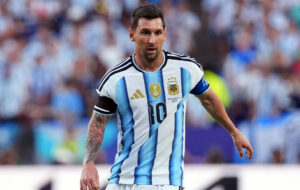
Lionel Messi just retired from the Argentina national team. A full retirement from soccer can’t be far away. He will be greatly missed.
Easily one of the greatest to ever play the game, Messi led Argentina to a World Cup title, Olympic gold medal, and two Copa America trophies. Along the way, he earned eight Ballon d’Or trophies as the world’s best player.
With all of these amazing achievements, you would think it came easy for him. Nothing could be further from the truth. So, what lessons can we learn from Messi’s journey?
Let’s start at the beginning.
At the age of four, Messi started soccer on a local team in his hometown of Rosario in the Santa Fe province of Argentina. His late father, Jorge Messi was his first coach. Messi began his formal youth club career at the age of seven when he began playing for a team in the Newell’s Old Boys youth system. Newell’s senior team is a member of the top flight league in Argentina.
Messi excelled at the club, scoring almost 500 goals in the six years that he played there. But things changed when Messi was a teen. At the age of 10, Messi was diagnosed with a growth hormone deficiency. He began growth hormone therapy for the condition when he was 11, but his family’s insurance covered only two years of the therapy.
Newell’s originally offered to pay for the therapy, but later backed out and at the age of 13 Messi got an opportunity to join the Barcelona youth academy in Spain. They paid his medical bills, but Messi could only play limited matches until a transfer conflict with Newell’s could be completed. Naturally shy and in a new country with limited opportunities to play, Messi was desperately homesick and struggled to click with the team. He was so quiet that some teammates actually thought he was mute.
A year later everything changed. Messi’s growth therapy program was concluded and the contract dispute with Newell’s was resolved. At 14, Messi played a key role on a Barcelona youth team that is widely considered the greatest that there famed academy, La Masia ever produced. Messi led the team with 36 goals in 30 games as it won a Spanish youth treble.
Messi quickly made his mark at Barcelona. At 16, he made his debut with the senior squad in a friendly against Porto and his first La Liga game followed at 17. During that season Messi became the youngest player to ever score a goal for the club. This marked the start of a wonderful career for Messi at Barcelona, where he was on ten La Liga championship teams and four Champions League title winners.
Messi’s 17-year career at Barcelona brought much glory and trophies, but during the same span he endured much heartbreak and struggle with the Argentina national team. Argentina’s fans developed a love-hate relationship with Messi that often got ugly when Argentina failed to win major competitions, which was often.
As good as Messi was, he often suffered negative comparison to Argentine idol Diego Maradona. Messi’s shyness could never match the extroverted machismo that Maradona possessed and naturally drew fans to him. More importantly, Maradona led Argentina to a World Cup championship in 1986 and his shadow over Messi grew darker and darker with every World Cup or Copa America that concluded with some other nation lifting the trophy.
Things got so dark for Messi that in 2016, still during the peak of his playing career, he announced his retirement from the Argentina national team after they suffered a devastating defeat to Chile in the final of the 2016 Copa America tournament. Coming off the heels of losing the 2014 World Cup final to Germany and the 2015 Copa America final (again to Chile), Messi could no longer bear the brutal criticism that he alone faced every time Argentina failed to win a championship.
Although Messi returned to play for Argentina, things still didn’t go immediately well for the team. In fact, they got worse. At the 2018 World Cup the Argentines suffered a humiliating 3-0 defeat to minnow Croatia in group play and were knocked out by eventual champion France in the round of 16, the earliest World Cup exit for Argentina since 2002.
And then everything changed.
Messi and his Argentina teammates finally were able to get the monkey off their back when they won the 2021 Copa America championship. Adding to the glory, it was archrival Brazil that Argentina defeated in the final on Brazilian soil in Rio De Janeiro. A year later, Argentina one upped themselves when they finally lifted the World Cup trophy after defeating France in a thrilling final.
The World Cup triumph showed how much Messi meant to his teammates. Several were quoted as saying that they were so happy to help him win it. They were all keenly aware of how much pressure Messi carried with him in all of the previous tournaments. His teammate and friend Angel Di Maria told Messi, “All the suffering is finally behind you.”
So, what can be learned from Messi’s journey? Here are four key things to always remember.
Exit the Comfort Zone: Getting out of your comfort zone is something many people are reticent to do, but true greatness demands it. Messi travelled across the globe, leaving behind family and friends, with no guarantee of success, to join Barcelona when he was just 13.
Failure Isn’t Permanent: Argentina lost in three consecutive finals, the 2014 World Cup and in 2015 and 2016 at Copa America. Facing intense pressure and public criticism, Messi stepped away from the national team, but his return paved the way for the success he enjoyed in winning the 2022 World Cup and the 2021 and 2024 Copa America titles. You can only respond to a loss with a win if you keep trying.
Shut Out the Noise: Admittedly, Messi struggled with the deep pain he felt from the brutal criticism that came after every tournament that Argentina failed to win. That is normal for any human being, but he didn’t let the noise impact his play on the field. Staying composed and focused while playing during times of high pressure is a true mark of greatness.
Choose the Light: Even with all the pain that Messi endured while playing for Argentina, on the night of his final game with the national team Messi described representing Argentina as “the most wonderful thing that can happen to you.” In all of the darkness, Messi chose to focus on the light. It is this determination to stay positive that separates the good from the great.